
Published on
About Us
Lorem ipsum dolor sit amet, consectetur elit, sed do eiusmod tempor incididunt ut labore et magna aliqua.
Get a free quote
Malaria Detection and Treatment for the Indigenous Orang Rimbo Community
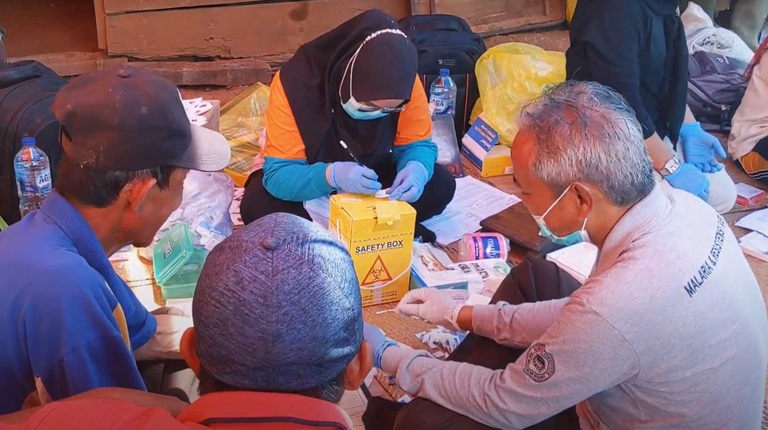
Besidam, 13, is a teenager from the indigenous Orang Rimbo community who lives with her parents near the Terab River. Her home is currently located in the middle of oil palm and rubber plantations. Unlike most children her age, Besidam does not attend school. Instead, she is learning how to continue her nomadic lifestyle as a hunter-gatherer.
The team from the Oxford University Clinical Research Unit - Indonesia (OUCRU - Indonesia) had to navigate slippery and muddy roads that are often only accessible by four-wheeled vehicles during the rainy season. It takes four hours from the capital of Batanghari Regency to reach Besidam and her community.
Malaria, locally known as kuro fever, is a common disease among the Orang Rimbo. The most frequently reported symptoms of malaria are intermittent fever, chills, and headaches. The Rimbo people often prefer to use traditional medicines such as Ngai Champor leaves (local name: campo or sembung, Latin: Blumea balsamifera), white teak shoots (sungkeh or sungkai, Peronema canescens), and long congkak roots (pasak bumi, Eurycoma longifolia).
If the disease worsens, the patient will be fed and moved to a sesudungan, a temporary shelter consisting of a wooden stilt house with a tarpaulin roof but no walls, in the forest. If the patient recovers, they will return to the community.
“Four to five years ago, many of us died of malaria. There were no health workers to examine or treat us. Medicinal plants disappeared because companies had cleared so much land. Look around, how can medicinal plants grow in these oil palm plantations?” asked Sigerum, a Rimbo community leader who handles social and cultural issues.
The Rimbo people often face structural barriers to accessing healthcare. Their most common challenges include their nomadic lifestyle, difficulty communicating with health workers due to language barriers, their isolated location, limited road access, and high transportation costs.
Tumenggung Ngelambo explained his hopes for better health services, saying, "We hope the Health Office will pay more attention and provide regular health services to our community, at least once or twice a week. It would be better if they were closer to us. That way, we can get treatment if we have a fever or other illness. Unlike now, when the fever gets worse, we still have to travel through poor roads."
As part of its efforts to reach everyone with health services, the government provides free health services to the Orang Rimbo community. At least once a month, a team from the nearest Community Health Center (Puskesmas) visits and provides health services, including malaria detection and treatment. This joint framework directly contributes to reducing malaria cases and preventable deaths among the vulnerable Orang Rimbo community.
The WHO Indonesia malaria program is supported by the Global Fund.
Written by Dr. Herdiana H. Basri, WHO Indonesia Malaria Officer, and Lenny Ekawati, Researcher at OUCRU-ID.
Further Reading & Related Reports:
To explore deeper tactical analyses and tailored malaria intervention workflows for indigenous populations within these forest enclaves, please download the comprehensive report below:
Download Report: Targeted Malaria Elimination in Indigenous Populations: Strategic Engagement with the Orang Rimba in Indonesia’s Forest Regions (PDF)
(This article is adapted from the official WHO Indonesia media release, which can be viewed here: WHO Indonesia News - Malaria Detection and Treatment for Indigenous Orang Rimbo Community)
Tags:

Tags: