
Published on

About Us
Lorem ipsum dolor sit amet, consectetur elit, sed do eiusmod tempor incididunt ut labore et magna aliqua.
Get a free quote
North Bolaang Mongondow Declares Malaria Outbreak; OUCRU Indonesia Researcher Asks: Where Has Malaria Re-entered?

Health workers from the North Bolaang Mongondow Health Office conduct an Anopheles larval survey in Huntuk Village as part of malaria surveillance and vector control activities. (Photo: North Bolaang Mongondow Health Office)
BOLMUT,SULAWESION.COM - The Health Office of North Bolaang Mongondow Regency (Bolmut) has reported nine malaria cases between April and June 2026.
The increase in cases has prompted the North Bolaang Mongondow Regency Government to declare a Malaria Outbreak (Extraordinary Event/KLB) in the district.
Commenting on the malaria cases in Bolmut, Dr Iqbal Elyazar, a malaria researcher at the Oxford University Clinical Research Unit Indonesia (OUCRU Indonesia), states that the current priority is to identify the source and location of transmission.
“The most important question today is not ‘How many cases have been detected?’ but rather ‘Where has malaria managed to re-enter?’”
“Answering that question will determine whether Bolmut is dealing with imported cases that have been successfully detected or the early signs of malaria reintroduction,” he explains.
The head of the Strengthening Health Initiatives for Eliminating Infectious Diseases in Papua (SHIELD PAPUA) research programme adds that the good news is that the earlier the source of transmission is identified, the greater the opportunity to stop it and sustain the malaria control achievements that have already been made.
“Every malaria case is a clue, not merely a statistic. The current priority is to follow those clues until the true source of the parasite and the location of transmission are identified. If the source can be found quickly, the chain of transmission can be broken,” he says.

Dr Iqbal Elyazar, malaria researcher at the Oxford University Clinical Research Unit Indonesia (OUCRU Indonesia) and Lead Investigator of the Strengthening Health Initiatives for Eliminating Infectious Diseases in Papua (SHIELD Papua) Research Programme.
He further notes that specific population mobility patterns, particularly among small-scale mining workers, represent an important risk factor requiring special attention.
“In the malaria elimination era, the main enemy is no longer the visible case, but the case that moves undetected.
“A worker who appears healthy may carry malaria parasites from an endemic area and unknowingly become the first link in a new chain of transmission.
“This is why strengthening migration surveillance is not merely an administrative activity; it is the frontline defence for protecting areas that have successfully controlled malaria.
“Malaria does not travel alone—it moves with people. Therefore, every incoming worker from an endemic area should be viewed as an opportunity for early detection, rather than waiting until cases emerge.
“Areas that successfully control malaria are those capable of identifying imported cases before malaria finds an opportunity to spread again.”
Dr Elyazar emphasises that Bolmut remains receptive to malaria transmission, and vigilance must therefore be maintained. The current outbreak declaration should not be interpreted as a reason to question the district’s malaria control achievements.
“On the contrary, this is a test of whether the surveillance system that has been built in Bolmut is capable of detecting, responding to, and halting transmission rapidly before malaria spreads further and affects more people.
“The Health Office has already undertaken the necessary measures. However, this event demonstrates that a low number of malaria cases is not the finish line. What matters more is a region’s ability to sustain the victories it has already achieved,” he says.
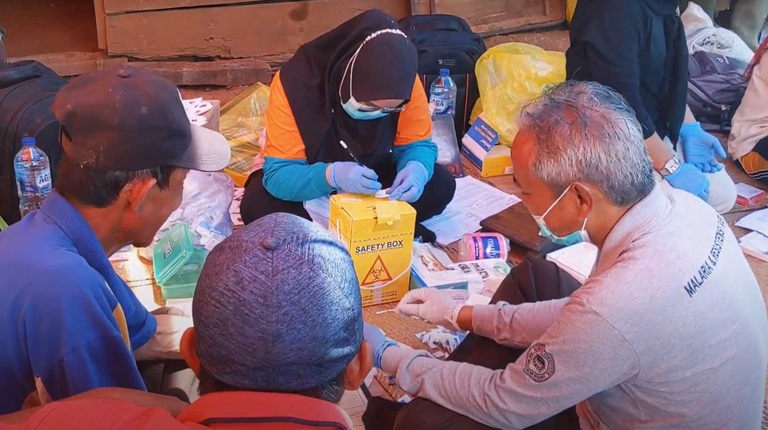
Earlier, on 9 June 2026, the Health Office of North Bolaang Mongondow Regency conducted a Malaria Mass Blood Survey (MBS), a screening activity carried out by health workers to detect malaria parasite infections within a population at an early stage.
The screening took place in Huntuk Village, Bintauna Subdistrict. Sofian Mokoginta, Head of the North Bolaang Mongondow Health Office, represented by Sri Yudi Kohongia, Head of the Disease Prevention and Control Division, states that the activity aims to detect malaria cases among mining workers and interrupt the chain of transmission.
“Based on reports of confirmed malaria cases between April and June 2026, a total of nine cases have been identified and classified as local (endogenous) transmission. Consequently, North Bolaang Mongondow Regency has been designated as an area experiencing a Malaria Outbreak (KLB),” she explains.
The Health Office has also coordinated with the Huntuk Village Government, conducted community awareness activities regarding the objectives of the programme, and compiled data on target populations for screening.
“The activities include blood sample collection using Rapid Diagnostic Tests (RDTs), recording examination results, providing health education, distributing insecticide-treated mosquito nets, surveying Anopheles larvae at mosquito breeding sites, and applying larvicides,” she says.
She reports that 25 individuals underwent malaria blood screening using RDTs, with all results returning non-reactive.
Larval surveys revealed numerous breeding sites suitable for Anopheles mosquitoes, the primary vector responsible for malaria transmission.
Subsequent investigations and observations confirmed the presence of Anopheles larvae, indicating that the area remains receptive to malaria transmission. As a result, the village has been categorised as an active malaria focus.
Click to Read: https://sulawesion.com/terkini/bolmut-klb-malaria-peneliti-oucru-indonesia-dimana-malaria-berhasil-masuk-kembali/
Tags:

Tags: