
Published on

About Us
Lorem ipsum dolor sit amet, consectetur elit, sed do eiusmod tempor incididunt ut labore et magna aliqua.
Get a free quote
Advancing Health Research Capacities, Varians Statistika Kesehatan and SHIELD PAPUA Host Roadshow Series on Spatial Analysis and NVivo Training
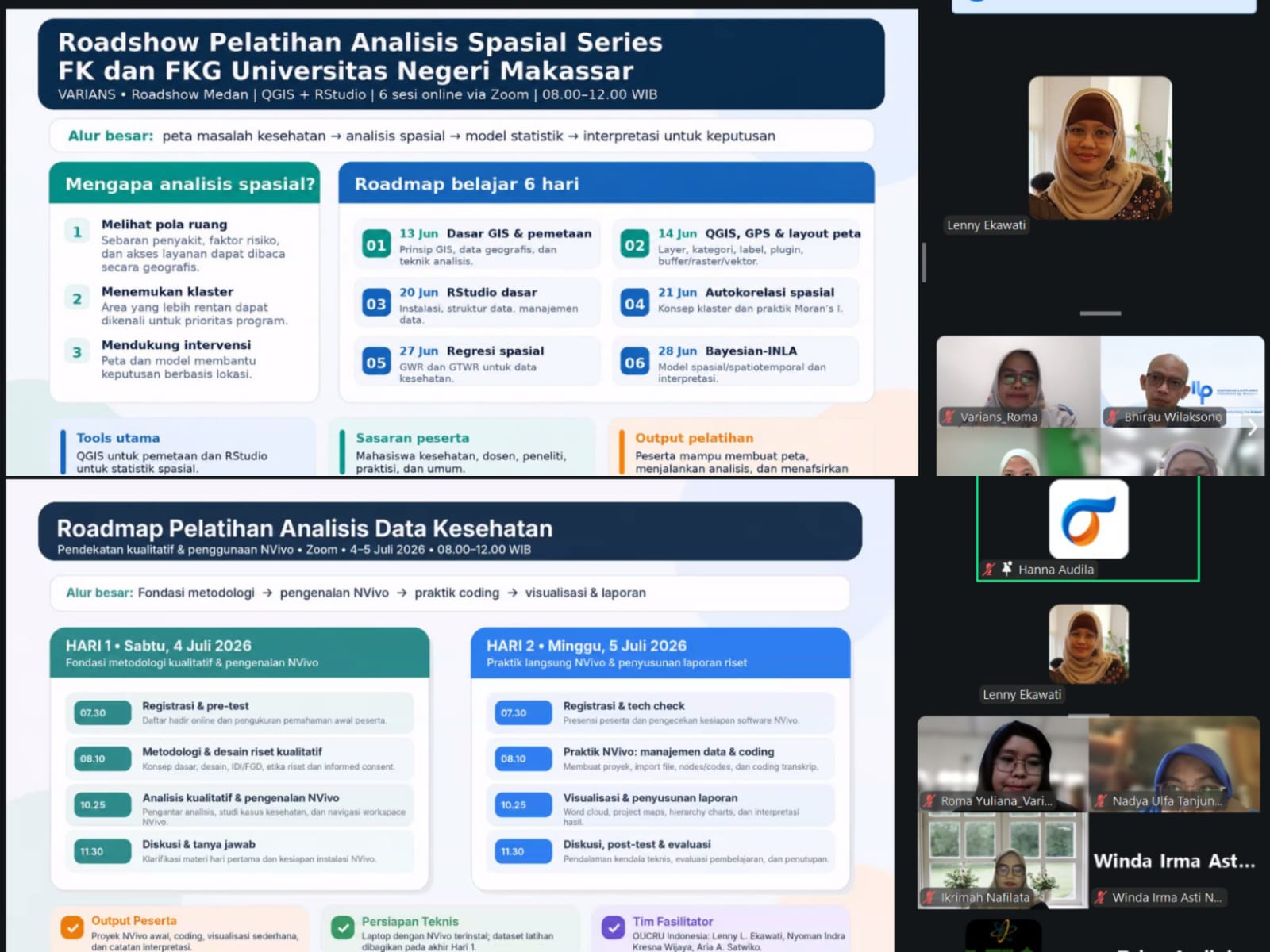
To strengthen the methodological foundations and research capabilities of health researchers, academics, and practitioners, Varians Statistika Kesehatan, in collaboration with the Oxford University Clinical Research Unit (OUCRU) Indonesia, successfully organized a virtual training roadshow series. The program, titled "Roadshow Pelatihan Analisis Data Kualitatif Bidang Kesehatan Menggunakan Software NVivo & Pelatihan Analisis Spasial Series", was delivered online to equip participants with cutting-edge analytical tools critical for contemporary public health research.
The roadshow series has been successfully conducted across two distinct sessions. The first session took place on June 26, 2026, and was actively attended by representatives from the Faculty of Public Health (FKM) at Universitas Islam Negeri Sumatera Utara (UINSU) Medan. The second session followed on June 30, 2026, engaging lecturers, researchers, and students from the Faculty of Medicine (FK) and the Faculty of Dentistry (FKG) at Universitas Negeri Makassar (UNM).
During the sessions, Dr. Lenny Ekawati alongside the OUCRU Indonesia Spatial Team comprehensively demonstrated the macro-workflow of health data analysis. This specialized training blended two pivotal methodologies in public health research. For the qualitative track, participants were guided through qualitative foundations, data management, direct thematic coding, and report visualization utilizing NVivo software, designed to capture deep structural and behavioral insights from health program implementations.
Concurrently, the spatial analysis track focused on leveraging the joint power of QGIS and RStudio. Through a structured layout, participants learned to visualize spatial patterns of disease and factors (descriptive spatial analysis) using QGIS, detect high-risk clusters using Spatial Autocorrelation (Moran's I), and construct advanced statistical models using Spatial Regression (GWR & GTWR) as well as Spatiotemporal Bayesian-INLA models. This multi-layered analytical approach empowers researchers to translate raw spatial data into evidence-based, location-specific policy interventions.
Through the active engagement of various universities across Indonesia in this training platform, this strategic collaboration is expected to accelerate the comprehensive utilization of health data. Equipped with robust spatial and qualitative analysis skills, regional academics can generate public policy recommendations that are more inclusive, accurate, and directly impactful in improving public health standards across diverse regions in Indonesia.
Tags:
Tags: