
Published on

About Us
Lorem ipsum dolor sit amet, consectetur elit, sed do eiusmod tempor incididunt ut labore et magna aliqua.
Get a free quote
Accelerating Global Publication: Poltekkes Kemenkes Medan Holds 2026 Scientific Writing Training with Leading Epidemiologist
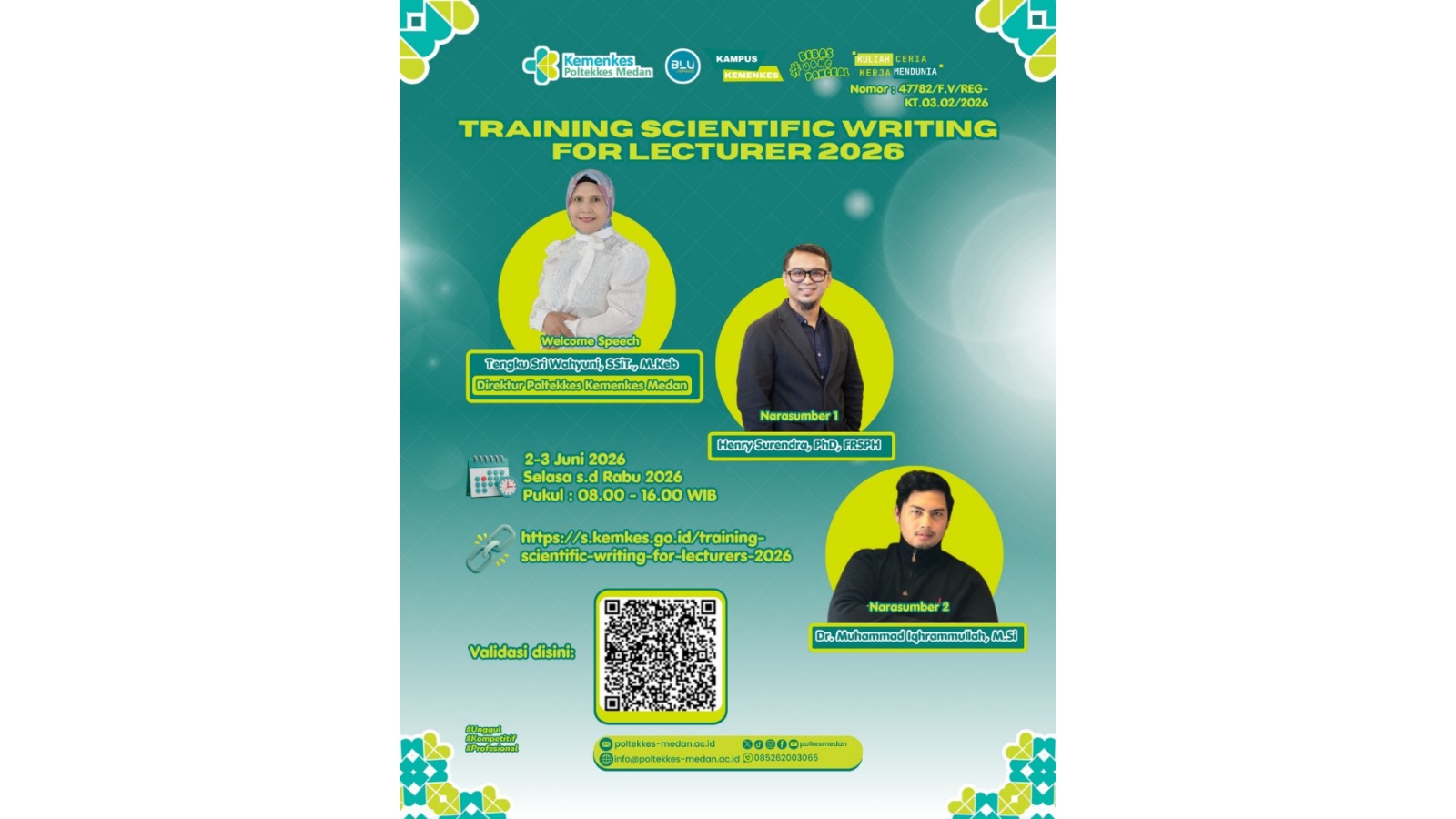

To scale up both the quantity and quality of international scientific publications, the Language Laboratory Unit of Poltekkes Kemenkes Medan successfully organized an intensive workshop titled "Training Scientific Writing for Lecturer 2026". The two-day event, held from June 2–3, 2026, was eagerly attended by lecturers across the institutional ecosystem. The program commenced with an official welcome speech delivered by Tengku Sri Wahyuni, S.Sit., M.Keb, the Director of Poltekkes Kemenkes Medan.
This strategic training was explicitly tailored to address the structural and technical constraints commonly faced by academics when transforming field research into high-quality English manuscripts that meet the benchmarks of top-tier indexed journals (such as Scopus or Web of Science). Through this hands-on workshop, lecturers were equipped with structural writing mastery, data visualization strategies, and robust academic logic required to successfully navigate peer-review processes.
Strategies for Publishing in High-Impact International Journals
The workshop featured renowned epidemiological expert Assoc. Prof. Henry Surendra, PhD, FRSPH, as Speaker 1. Dr. Henry, who holds appointments as an Associate Professor at Monash University Indonesia and a researcher with the Oxford University Clinical Research Unit Indonesia (OUCRU ID) and the SHIELD Papua initiative, delivered a core presentation titled "Breaking Barriers: Strategies and Foundational Skills to Publish Research in International Journals". He shared empirical insights and real-world case studies from his extensive publication record in world-renowned journals, including The Lancet Global Health and Nature Communications.
During his presentation, Dr. Henry highlighted the necessity of reframing local research to make it internationally relevant. This is achieved by embedding field findings within pressing global frameworks, such as the Sustainable Development Goals (SDGs) and planetary health paradigms. Participants were guided through the intricacies of the journal editorial cycle, effective ways to handle stressful reviewer comments, and the professional art of submitting formal appeal letters for rejected manuscripts.
Dissecting the IMRaD Anatomy and Manuscript Governance
The technical session was spearheaded by Speaker 2, Dr. Muhammad Iqhrammullah, M.Si, who walked the participants through structural analysis and manuscript drafting. The training closely examined the standard IMRaD (Introduction, Methods, Results, and Discussion) structure as coherent units of thought:
- Introduction (~10%): Sharply defining the research gap and establishing the scientific novelty of the study.
- Methods (~30%): Outlining research design, sampling frameworks, and statistical workflows transparently to ensure replicability.
- Results (~30%): Displaying outputs honestly and concisely using self-explanatory declarative tables and figures.
- Discussion (~20%) & Conclusion (~10%): Interpreting the findings within a wider global context, critically addressing limitations, and defining clear clinical or practical implications.
Beyond mastering article anatomy, the lecturers received comprehensive guidance on digital reference management tools like Mendeley for automated citations, maintaining global publication ethics, and evaluating target journals via databases like ScimagoJR to aggressively avoid predatory publishers. Through this collaborative initiative, Poltekkes Kemenkes Medan reinforces its long-term commitment to fostering an independent, excellent, and globally impactful health research ecosystem.

Tags:
Tags: