
Published on

About Us
Lorem ipsum dolor sit amet, consectetur elit, sed do eiusmod tempor incididunt ut labore et magna aliqua.
Get a free quote
From Systems Thinking to Decision-Making: Building Public Health Leadership in Papua
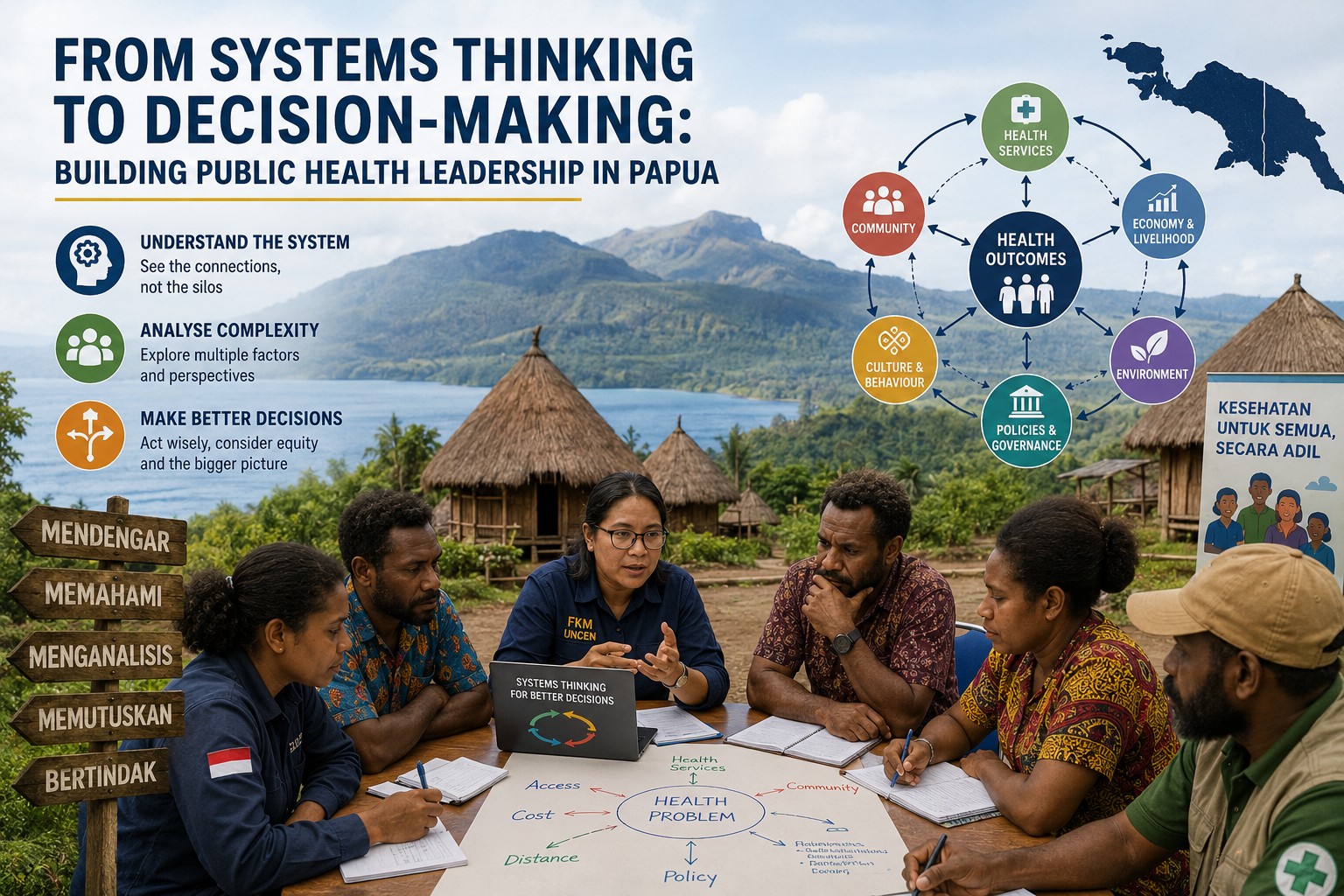
In the Master of Public Health programme at the Faculty of Public Health, Cenderawasih University, the Health Administration and Policy course taught by Dr Lenny L. Ekawati is designed to help students understand public health challenges in a more systematic and context-sensitive way. This year, the course brought together 50 students from across the six provinces of the Land of Papua, creating a diverse learning environment where participants contributed perspectives from urban, rural, coastal, island, highland, and remote settings. The course goes beyond theories of health policy and management by encouraging students to think critically, recognise the interconnections between different factors, and make decisions in situations characterised by uncertainty.
The course begins with an introduction to the foundations of health systems and leadership. Students are encouraged to understand that a health system consists of far more than hospitals, community health centres (Puskesmas), health professionals, and medicines. It encompasses the full range of actors, resources, policies, information systems, and processes that contribute to population health. Within the context of Papua, students are challenged to consider how leadership plays a vital role in connecting these different components of the health system, particularly in settings where resources are limited, geographical barriers are substantial, and access to services remains uneven.
In the following sessions, Dr Lenny introduces systems thinking as an approach to understanding complex public health problems. Students learn that issues such as stunting, malaria, HIV, tuberculosis, and low immunisation coverage cannot be explained by a single cause. Instead, social, economic, cultural, environmental, and health system factors interact in ways that shape health outcomes. This perspective helps students recognise relationships between different parts of the system and move beyond fragmented or sector-specific ways of thinking.
The final component of the course focuses on decision-making within health systems. Through a series of case studies drawn from the Papuan context, students explore the idea that not all public health problems are alike. Some are relatively simple, while others are complicated, complex, or even crisis situations, each requiring a different approach. Students learn how to move from understanding a problem to taking action through a structured decision-making process, while taking account of uncertainty, resource constraints, and community needs.
Through this learning journey, Dr Lenny hopes that students will become more than policy analysts who can interpret data and health programmes. The broader goal is to develop future public health leaders who can think systemically, make thoughtful and informed decisions, and advocate for more equitable health services for all communities across the Land of Papua.
Tags:

Tags: